
English| EUR
Suggested for you
More currencies
Choose a language
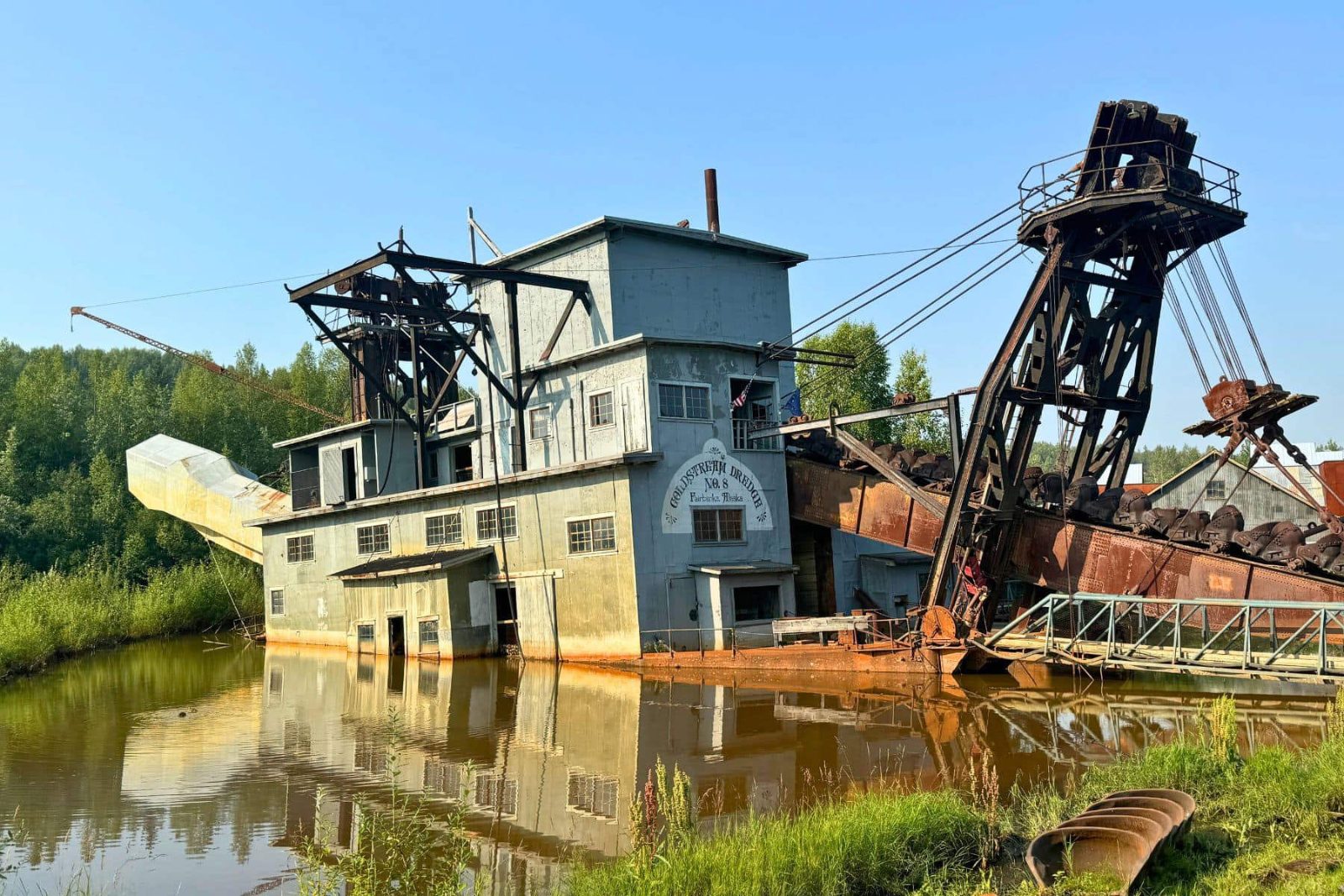
Gold Dredge 8 sits on Old Steese Highway north of Fairbanks, the last of Alaska's enormous bucket-line dredges still open to the public. This guide covers what to expect, how the site works, and what you need to plan a visit to one of the Interior's most tangible links to the gold rush era.
Quick answer
Gold Dredge 8 offers daily guided tours that include access to the historic dredge, a demonstration of sluicing techniques, and hands-on gold panning on the original mining claim. The site is open seven days a week from 9:00 AM to 5:00 PM, with tours departing throughout the day. Entry to the grounds is free, but access to the dredge itself and panning activities requires a tour reservation.
Gold Dredge 8 processed eight million cubic yards of pay dirt between 1928 and 1959, extracting more than seven and a half million dollars in gold at Depression-era prices. The five-deck, 250-ton machine now rests where it stopped, surrounded by the tailing piles it left behind and the permafrost tunnels that fed its operation. Guided tours walk visitors through the dredge's mechanical systems—the bucket line that scooped gravel from the thaw ponds, the rotating trommels that separated stones by size, the sluice runs lined with Hungarian riffles and coconut matting. Interpreters explain how a crew of fewer than twenty men could move a dredge the length of a football field in a single season, and why Alaska's gold mining operations required engineering solutions found nowhere else. The tour ends at a working sluice box where each visitor pans a bag of concentrate seeded with Alaskan gold, keeping whatever they recover. The site preserves not only the dredge but the landscape it created. Tailings stretch in parallel ridges across the property, marking the dredge's path as it chewed north along Goldstream Creek. A segment of permafrost tunnel remains accessible, its walls still frozen year-round despite summer air temperatures, showing the ice lens that locked Interior Alaska's richest placers beneath the surface until miners learned to thaw them with steam points and wood fires. The Trans-Alaska Pipeline crosses the property's eastern edge, a reminder that resource extraction never entirely left the region. Gold mining Fairbanks Alaska centered on dredges like this one through the first half of the twentieth century. More than a hundred operated across the Tanana Valley; Dredge 8 is the sole survivor open to interpretation. The site operates as a working historical attraction rather than a static museum—the sluice still runs, the gold is real, and the mechanics remain demonstrable.
“The five-deck, 250-ton machine now rests where it stopped, surrounded by the tailing piles it left behind and the permafrost tunnels that fed its operation.”
The most effective time to experience Gold Dredge 8 is during the summer season, specifically within the 09:00–15:00 arrival window. Visiting during these hours ensures you avoid peak daily tour congestion and allows sufficient time to complete all activities before closing.
Highs of 70°F to 75°F
These months offer the most consistent weather and full operational capacity for all outdoor mining demonstrations.
—
Arriving between 09:00 and 11:00 typically results in smaller tour group sizes compared to afternoons.
Highs of 50°F to 60°F
Cooler temperatures and thinner crowds characterize the final weeks of the operating season.
Verdict: Plan your visit for a weekday morning between 09:00 and 11:00 during the months of June or July to balance weather conditions with manageable crowd levels.
Gold Dredge 8 operates on a consistent schedule throughout the week to accommodate visitors interested in Fairbanks mining history.
Access to the Gold Dredge 8 grounds is free of charge, allowing visitors to view the site. Participation in gold panning activities and internal access to the historic dredge require the purchase of a tour.
Verdict: While grounds access is free, visitors pay for a tour to access gold panning and the dredge, with costs varying based on the specific tour package selected.
Gold Dredge 8 is located north of downtown Fairbanks. The most direct approach is by vehicle via the Old Steese Highway.
Follow Old Steese Hwy N to 1803 Old Steese Hwy N
Direct service to 1803 Old Steese Hwy N
Parking is available on-site at the main entrance. Plan your trip to arrive between 09:00 and 15:00 to navigate the site efficiently before closing.
Gold mining Fairbanks Alaska began in earnest after Felix Pedro's 1902 discovery along the Tanana Valley, igniting a rush that transformed the Interior into one of the territory's richest camps. By the 1920s, hand operations gave way to industrial dredges—massive bucket-line machines that could process permafrost ground previously beyond reach. The Fairbanks Exploration Company commissioned Gold Dredge 8 in 1928, assembling five decks of machinery capable of excavating, washing, and sorting eight thousand cubic yards of gravel daily. Engineers floated the hull into Davidson Ditch, a ninety-mile canal delivering hydraulic water from the Chatanika River. The dredge worked a continuous arc through Fox and Goldstream valleys, advancing roughly fifty feet each month and leaving windrows of tailings that still stripe the tundra. Crews lived in the bunkhouse visible beside the hull, operating around the clock during summer's endless daylight. Production peaked in the late 1930s, when Fairbanks gold operations supplied strategic reserves ahead of global conflict. Dredge 8 shut down in 1959 after three decades, its retirement marking the end of large-scale bucket dredging in the region. Today the dredge rests where it stopped, hull intact and machinery accessible during guided tours. Visitors board the same decks miners once walked, inspecting the hopper, sluice runs, and gold-recovery tables. The site preserves bunkhouse quarters, the narrow-gauge rail spur, and interpretive displays tracing Fairbanks' evolution from placer camp to mechanized district. Tailings ridges frame the property, a durable record of industrial-era extraction across Interior Alaska.
Felix Pedro discovers gold near present-day Fairbanks, triggering the Interior Alaska rush.
Fairbanks Exploration Company begins mechanizing claims with bucket-line dredges to mine frozen ground.
Gold Dredge 8 enters service, processing up to 8,000 cubic yards of gravel per day.
Peak production supplies strategic gold reserves; dredge crews operate year-round shifts.
Dredge 8 ceases operations after three decades, marking the end of large-scale dredging in the Fairbanks district.
The dredge remains on-site as a preserved artifact, open for tours demonstrating industrial mining history.
Reserve your tour in advance and prepare for outdoor conditions at this active mining site.
Everything you need to know about gold mining fairbanks alaska
Gold Dredge 8 provides public access to explore the site where industrial gold mining fairbanks alaska occurred. While the grounds are open, you must join a formal tour to access the historic dredge and participate in gold panning.
Entry to the grounds is 0 USD. Please note that a tour is required for actual access to the dredge and gold panning opportunities.
The best arrival window is 09:00–15:00. Arriving early helps you avoid mid-day tour crowds and ensures you have enough time to complete your visit before the 17:00 closing time.
Yes, the hands-on panning activities are suitable for families and children. This Fairbanks landmark offers an educational look at prospecting techniques that visitors of all ages can enjoy.
While walk-ins may be accommodated depending on availability, booking your spot ahead of time ensures your place on a tour. This helps streamline your visit to this historic site.
Comfortable walking shoes and layers are recommended for your visit to this Alaska landmark. Be prepared for outdoor conditions as you explore the sediment and sluice boxes found at the site.